We may earn a commission when you buy through our links. Learn more
Choose a dehumidifier from our list of 45 models with published watts (Meaco, Pro Breeze, EcoAir, Ebac, Princess), the hours it runs each day and the length of your damp season. The result gives the cost per hour, per day, per month and per season, then lists the models of the same type that publish at least as many litres a day, cheapest to run first.
How the calculation works
- Cost per hour = published watts ÷ 1,000 × your unit rate. Example: a 151 W Meaco Arete One 12L uses 0.151 kWh in an hour, so 0.151 × 26.32p = 3.97p [calc].
- Per day = cost per hour × hours a day. Per month = per day × 30. Per season = per day × 30.4 days × the months you enter (6 by default: roughly October to March, our assumption).
- Default rate: 26.32p per kWh, the electricity unit rate of the Ofgem price cap for 1 October to 31 December 2026 (Direct Debit, average for England, Scotland and Wales), read on ofgem.gov.uk on November 14, 2026. Ofgem sets a new cap each quarter: the rate from January 2027 was not on the page that day.
- Watts: the maker's figure. Meaco, Ebac and Princess publish watts; Pro Breeze publishes an "Energy Consumption" in kWh per hour (0.27 kW·h for the OmniDry 20L), which we read as 270 W; EcoAir publishes a low and a high figure for its desiccant models, so the calculator lets you pick the setting.
- Flat out: the calculation assumes the compressor or heater runs for every hour you enter. A humidistat stops it when the room is dry enough, so your bill is usually lower. Enter the hours it really runs.
What the numbers say
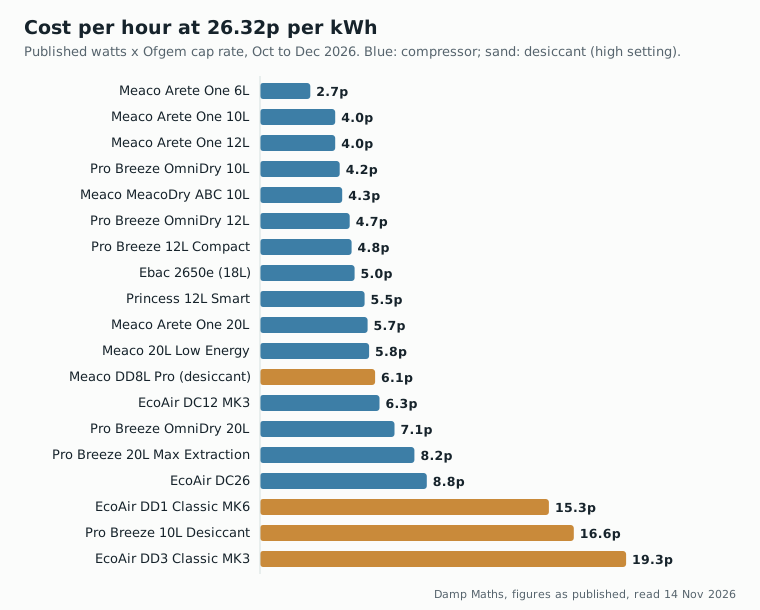
Among compressor models of 10 to 12 litres a day, the gap is small: from 3.97p an hour (Meaco Arete One 10L and 12L, 151 W) to 6.3p (EcoAir DC12 MK3, 240 W on high) [calc]. Over a six-month season at eight hours a day, that is about £58 against £92 [calc]. The bigger gap is between technologies: an EcoAir DD1 Classic desiccant draws 580 W on its high setting, so 15.3p an hour, almost four times a 151 W compressor model [calc]. Desiccant models earn that cost in cold rooms, where compressor models extract far less: see compressor vs desiccant.
All 45 models, ranked by cost per hour, are on how much a dehumidifier costs to run per hour. To choose a model rather than a cost, see the dehumidifier comparison and its picks. Drying washing? The dehumidifier vs tumble dryer calculator works out the cost of one load.
Frequently asked questions
How much does a dehumidifier cost to run per hour in the UK?
Its watts divided by 1,000, times your unit rate. At the Ofgem cap rate of 26.32p per kWh (1 October to 31 December 2026), the models we compared run from 2.7p an hour (Meaco Arete One 6L, 101 W) to 19.4p an hour (EcoAir DD3 Classic MK3, 735 W on its high setting) [calc]. Most 10 to 12 litre compressor models sit between 4p and 5.5p an hour.
Why is the real cost often lower than the figure here?
Because the calculator assumes the dehumidifier runs flat out for every hour you enter. With a humidistat, the compressor stops once the room reaches the humidity you set, and only the fan keeps going. That is why the hours a day are yours to enter: count the hours it actually runs, not the hours it is plugged in.
Which electricity price should I use?
The unit rate on your bill. If you are on a standard variable tariff paid by Direct Debit, the Ofgem cap for 1 October to 31 December 2026 averages 26.32p per kWh across England, Scotland and Wales, which is the default here. Your region, payment method or fixed deal can differ: type your own rate.
Do you include the standing charge?
No. You pay the standing charge whether or not the dehumidifier is plugged in, so it does not change the cost of running one.